
Parents of approximately 750,000 students in Alberta can soon prepare to send their children back to school, as the provincial government has enacted legislation to resolve a contract conflict that has kept educators from teaching since early October.
Early Tuesday morning, Bill 2, known as the Back to School Act, was approved after a lengthy session for lawmakers in the provincial legislature. The legislation was introduced by Premier Danielle Smith’s administration the previous day.
This law mandates that striking teachers return to work as soon as Wednesday by imposing a collective agreement and utilizing the notwithstanding clause to protect it from judicial review for the length of the four-year contract.
The government employed legislative measures to restrict discussions on all three readings of the bill.
At a news conference earlier on Monday, Smith stated, “Our goal is to pass this legislation promptly and conclude the strike initiated by the Alberta Teachers’ Association (ATA). I anticipate that both students and teachers will resume classes on Wednesday.”
The United Conservative Party, led by Smith, holds 47 out of 87 seats in the Alberta legislature.
During the legislative session on Monday night, Finance Minister Nate Horner mentioned that the implementation of the notwithstanding clause would guarantee that “when classrooms reopen, they remain open.”
Opposition members reacted with loud laughter during Horner’s address and shouted “shame” when the notwithstanding clause was referenced.
Government house leader Joseph Schow successfully moved motions to curtail debate.
In response, NDP MLA Heather Sweet, representing Edmonton-Manning, labeled the allocation of just one hour for debate as “an outright betrayal of democracy in the making.”
“Limiting time is a crude tool, not a safeguard against constitutional violations,” she remarked. “When combined with the notwithstanding clause, it represents a significant threat to our democratic process.
“This is not about legislative efficiency; it’s about legislative oppression.”
Naheed Nenshi, leader of the Official Opposition NDP, spoke extensively in the legislature against the bill and shared statements and letters from constituents throughout the province.
Nenshi expressed his belief that Bill 2 is unconstitutional and asserted that there are “more effective means to achieve our objectives.”
Earlier on Monday, Smith mentioned that the situation was unique due to the dual-stage approach to collective bargaining. The bill aims to avert strikes at both levels.
“There are two opportunities for a strike, not just at the provincial table, but also at the local level,” Smith explained. “If strikes are permitted at 61 different school boards, it fails to provide the certainty we require.”
The ATA represents 51,000 teachers who initiated their strike on October 6.
Teachers have turned down two agreements their negotiating team reached with the Teachers’ Employer Bargaining Association (TEBA).
Bill 2 has legislated the terms of a tentative agreement that was rejected by nearly 90% of Alberta’s teachers last month.
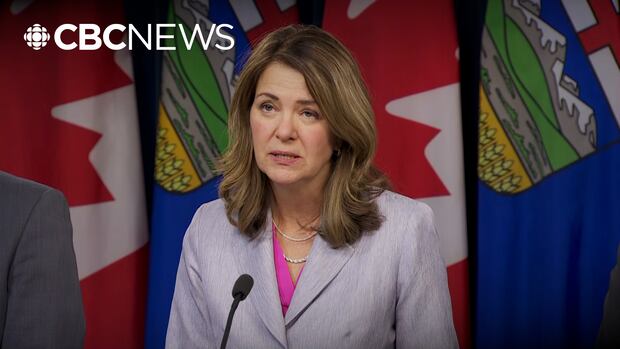
Alberta’s provincial government has released details of its back-to-work legislation aimed at striking teachers.
ATA criticizes use of notwithstanding clause
The notwithstanding clause is a provision in the Canadian Charter of Rights and Freedoms that allows provincial and territorial governments to bypass or disregard constitutionally protected rights in their legislation for a five-year duration.
Jason Schilling, president of the ATA, observed from the gallery as the bill was introduced just before 6 p.m. on Monday.
He expressed his outrage regarding the bill in comments to reporters outside the legislature.
“We witnessed a government exerting its power,” Schilling stated. “We observed a government using the legislature to force through what they consider a just settlement and employing the notwithstanding clause to restrict teachers’ rights.”

Jason Schilling, president of the Alberta Teachers’ Association, was furious the province is invoking the notwithstanding clause in legislation forcing teachers back to work. (Emmanuel Prince-Thauvette/Radio-Canada)
Schilling warned that if the government is willing to use the notwithstanding clause against teachers, it could potentially apply it against anyone in Alberta.
“What transpired inside today is a disgrace to our legislature,” he said. “It is an affront to democracy.”
In a statement released early Tuesday morning, the ATA announced plans to “explore all legal avenues to contest Bill 2’s blatant infringement on the collective bargaining rights of teachers and, by extension, all workers.”
Other public sector unions have indicated they may take job actions in solidarity with teachers should Bill 2 include the notwithstanding clause.
Nenshi stated that he believes Smith’s decision to invoke the notwithstanding clause positions her as “the most authoritarian premier in Canadian history.”
He asserted that Smith had alternatives with the bill, including the option to send the matter to binding arbitration.
Nenshi expressed concerns regarding the backlash he anticipates the UCP government will encounter from Albertans due to Bill 2.
“The premier has awakened parents, teachers, students, and workers,” he noted. “She has stirred everyone who desires a better Alberta, and she will regret the day she took this action.”
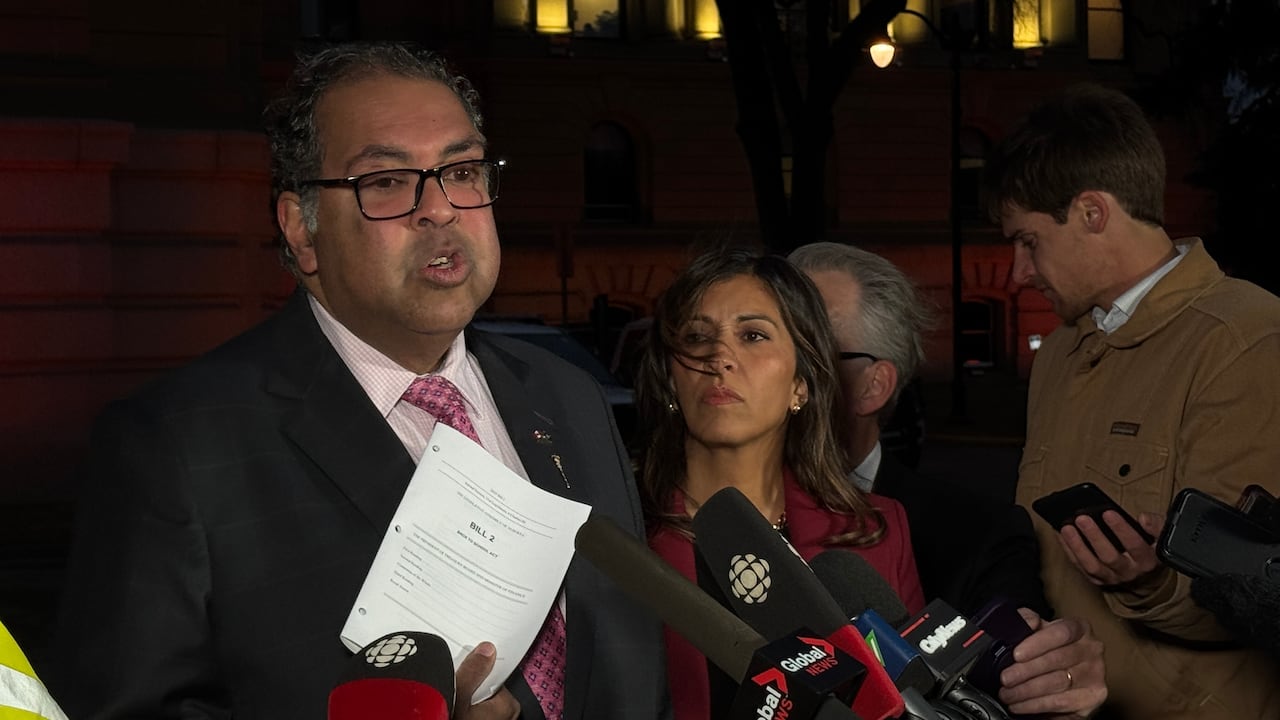
Alberta NDP Leader Naheed Nenshi holds a copy of Bill 2 while speaking to reporters outside the Alberta legislature Monday evening. (Emmanuel Prince-Thauvette/Radio Canada)
The collective agreement established by Bill 2 will be in effect from September 1, 2024, to August 31, 2028.
It includes annual salary hikes of three percent and commits the government to hiring 3,000 teachers and 1,500 educational assistants over the next three years.
Bill 2 imposes financial penalties of $500 per day for individuals who do not adhere to the back-to-work mandate and can impose fines up to $500,000 for the union daily if it fails to comply with the legislation. Additionally, the bill suspends local bargaining until 2028.
The government maintains that its proposal is equitable. The ATA is advocating for the government to tackle issues such as large class sizes and support for the complexities of students in the classroom.
Last summer, the province established an action team to assess aggression and complexity among students in Alberta schools, with the final report expected next month.
Following that, a newly formed task force dedicated to addressing class size and complexity will begin implementing solutions and gathering additional data on the matter from school boards.
The Alberta government is introducing the class size and complexity task force. Premier Danielle Smith shares a bit about what this will look like.
Tag: rewrite-pending

