
On Monday, a split decision from a U.S. appeals court determined that Donald Trump is permitted to deploy National Guard troops to Portland, Oregon, despite opposition from the city’s and state’s leaders. This ruling represents a significant legal win for the Republican president, as he continues to send military forces to an increasing number of cities governed by Democrats.
A panel of three judges from the 9th U.S. Circuit Court of Appeals granted the Justice Department’s appeal to pause a lower court’s injunction that had prevented the troop deployment while a legal challenge regarding Trump’s actions is considered.
The court concluded that the deployment of the National Guard was a suitable measure in response to demonstrators who had vandalized a federal building and posed threats to U.S. Immigration and Customs Enforcement personnel.
The majority opinion, which was not signed, was supported by Circuit Judges Bridget Bade and Ryan Nelson, both of whom were appointed by Trump during his first term. Nelson penned a concurring opinion, asserting that the courts lack the authority to review the president’s decisions regarding troop deployments.
In dissent, Circuit Judge Susan Graber, appointed by Democratic President Bill Clinton, argued that allowing military troops to be mobilized in response to “merely inconvenient” protests is “not only absurd” but also perilous. She advocated for the full 9th Circuit to reverse the ruling before Trump could send troops.
Oregon Attorney General Dan Rayfield also urged the 9th Circuit to reconsider its decision, claiming that the ruling places the nation on a “dangerous path.”
“If today’s ruling is upheld, it would grant the president the authority to deploy Oregon soldiers onto our streets with little justification,” Rayfield stated.
White House spokesperson Abigail Jackson praised the ruling, asserting that Trump was exercising his lawful power to safeguard federal assets and personnel from protesters.
Trump has requested that the U.S. Supreme Court evaluate his authority to send troops to cities led by Democrats, following a previous ruling from another U.S. appeals court that opposed his decision to deploy troops to Chicago.
Judges divided on whether deployment is warranted
U.S. District Judge Karin Immergut, appointed by Trump, ruled on October 4 that the president likely acted unlawfully in ordering troops to Portland. She had prohibited Trump from sending National Guard troops to the city until at least the end of October and has scheduled a non-jury trial to start on October 29 to decide whether to impose a longer-term injunction.
On September 27, Trump directed 200 National Guard troops to Portland, continuing his administration’s unprecedented use of military forces in U.S. cities to quell protests and reinforce domestic immigration enforcement. Trump described the city as “War ravaged” and stated, “I am also authorizing Full Force, if necessary.”
Democratic-led states seek to halt deployments
In a remarkable deployment of the U.S. military for domestic purposes, Trump has sent National Guard troops to Los Angeles, Washington, D.C., and Memphis, and has announced intentions for deployments to Portland and Chicago.
States and cities governed by Democrats have initiated lawsuits to stop the deployments, with courts yet to arrive at a definitive ruling on the legality of Trump’s decisions to send the National Guard to urban areas in the U.S.
City and state officials have taken legal action against the administration in an effort to prevent the Portland deployment, asserting that Trump’s actions contravene multiple federal laws concerning the military’s use and infringe upon states’ rights under the 10th Amendment of the U.S. Constitution.
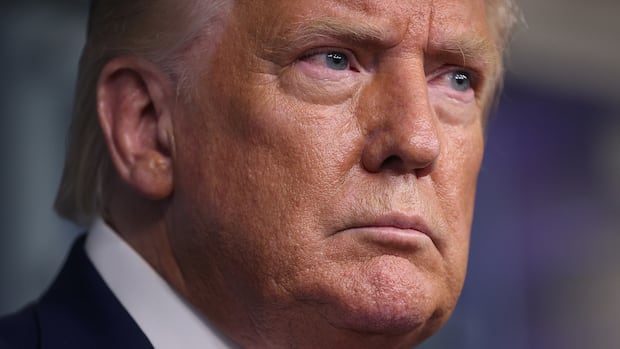
Donald Trump’s plan to send the National Guard ‘to protect war-ravaged Portland’ has been met with bewilderment from many people who live there. For The National, CBC’s Ashley Fraser tries to get to the bottom of the U.S. president’s fixation on the Oregon city.
The lawsuit accused Trump of overstating the severity of protests against his immigration policies in order to justify the unlawful seizure of control over state National Guard units.
Records from the police indicated that protests in Portland were “small and sedate,” resulting in merely 25 arrests in mid-June and no arrests in the three-and-a-half months following June 19.
Typically, the Posse Comitatus Act restricts the military’s deployment for domestic law enforcement. In deploying troops to California, Oregon, and Illinois, Trump has cited a law—Section 12406 of Title 10 of the U.S. Code—that permits a president to mobilize state National Guard troops to repel an invasion, suppress a rebellion, or facilitate law enforcement.
The National Guard operates as state-based militia forces that report to state governors unless activated by the president for federal service.
In reviewing Trump’s assertion in September that protests had created an “inability” to enforce federal law in Portland, the 9th Circuit judges differed on what evidence was relevant.
The majority referenced evidence from June, when more intense protests caused the ICE headquarters in Portland to close for three weeks, along with unrelated incidents such as a shooting at an ICE facility in Dallas.
Graber argued that there was no emergency in the city, highlighting that protests had been peaceful for weeks prior to Trump’s troop deployment, with activities mostly involving individuals “wearing chicken suits or inflatable frog costumes” rather than the violent rioters described by officials in the Trump administration.
Immergut ruled against the administration on October 4 and 5, first determining that Trump could not take control of Oregon’s National Guard and later stating that he could not bypass that ruling by calling in National Guard units from other states.
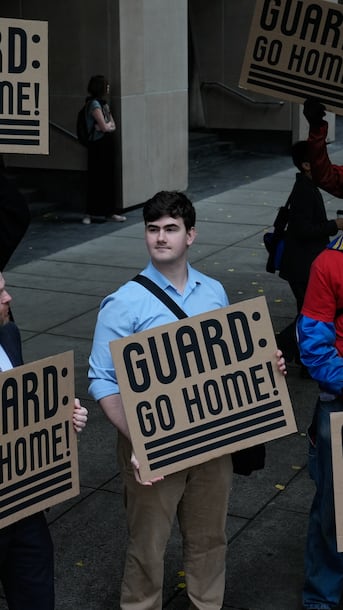
U.S. President Donald Trump states he’s deploying the National Guard ‘to protect war ravaged Portland,’ in a social media post on Saturday. CBC’s Julia Wong spoke with some of the city’s residents ahead of the troops’ arrival, who offered a different perspective on what they’re seeing.
The judge pointed out that there was no evidence indicating that the recent protests in Portland constituted a rebellion or significantly disrupted law enforcement, asserting that Trump’s characterization of the city as war-ravaged was “entirely disconnected from the facts.”
Immergut is among three district court judges who have ruled against Trump’s National Guard deployments, and no district court judge has yet supported Trump in these matters.
So far, appeals courts have been divided on the subject, with the 9th Circuit previously supporting Trump’s deployment of troops in California while the 7th Circuit ruled that troops should remain out of Chicago for the time being.
Tag: rewrite-pending

