
The group representing some of the largest spirit manufacturers in the United States is urging the Nova Scotia Liquor Corporation (NSLC) to abolish a policy that favors local spirit products with lower markups.
In a recent 77-page document submitted to the Office of the United States Trade Representative, the Distilled Spirits Council of the United States highlighted various trade obstacles they encounter in several countries.
The section regarding Canada spans six pages, documenting issues such as the ban on American alcohol sales in most provinces and the preferential markups on local spirits in Alberta, Saskatchewan, New Brunswick, Prince Edward Island, Nova Scotia, and Newfoundland and Labrador.
In Nova Scotia, spirits that are distilled or blended and bottled within the province face markup percentages between 50 and 80 percent, while all imported and non-local spirits are subjected to a markup of 160 percent.
The Distilled Spirits Council argues that these markups contradict trade agreements, as they protect local products while discriminating against imported spirits.
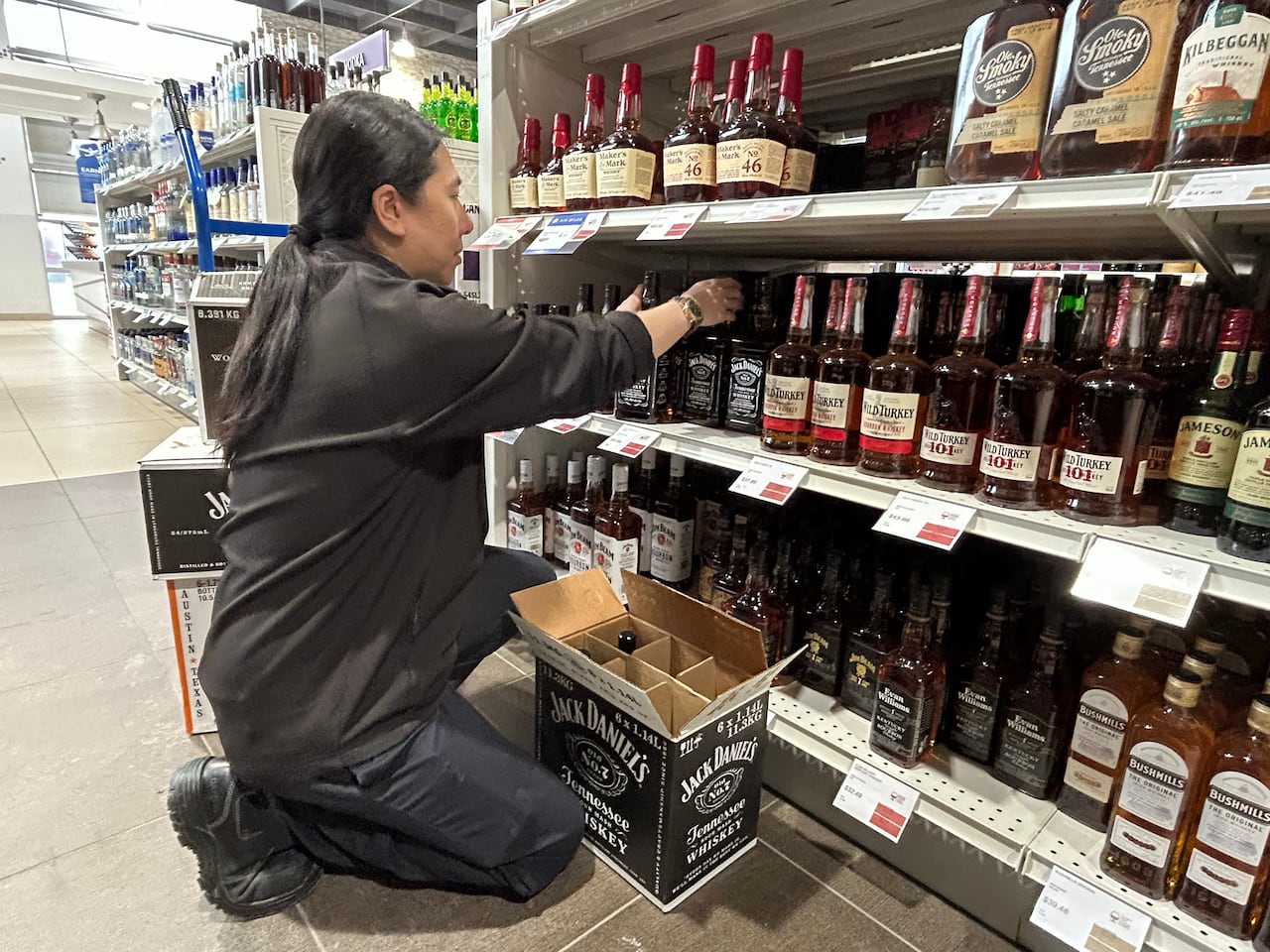
An NSLC employee removes bottles of Jack Daniel’s from a store shelf earlier this year as part of the corporation’s response to the trade war with the U.S. (Nova Scotia Liquor Corporation)
The council is seeking assistance from the U.S. government to “encourage Canada and the provinces of Alberta, Nova Scotia, New Brunswick, Prince Edward Island, Saskatchewan, and Newfoundland and Labrador” to eliminate the NSLC’s current policy.
It remains unclear why the council, which did not respond to a request for an interview, believes that other provinces are involved in the NSLC’s policies.
-
With American alcohol back on NSLC shelves, what are the top sellers?
-
Removal of U.S. products benefited local sales, NSLC says
-
‘That’s a lot of bottles!’: Uncorking the value of American booze pulled from NSLC shelves
The province’s Intergovernmental Affairs Department indicated that it has not received any formal complaints regarding this issue from either the Distilled Spirits Council or the U.S. government through the established trade dispute channels.
A statement from the department emphasized, “Nova Scotia remains dedicated to fulfilling its trade commitments and collaborating with partners through the appropriate avenues.”
The NSLC stated that it has historically maintained preferential markups on local products in alignment with its mission to bolster Nova Scotia’s beverage alcohol sector and create an equitable environment for local producers.
Challenges for U.S. spirit producers
This report emerges amid a nine percent decrease in U.S. spirit exports during the first half of 2025, compared to the same time frame the year before.
The report highlights, “This decline indicates the effects of retaliatory tariffs and other measures, escalating trade tensions, and barriers to market access in crucial markets.”
-
American spirit exports to Canada ‘plummeted’ 85%, says U.S. trade group
-
Company behind Jack Daniel’s says boycott is ‘significant’ as sales to Canada fall 62%
The report also noted that international consumers seem to be opting for domestic or alternative imports, “possibly as a reaction to perceived unfair trade practices by the U.S.”
The Craft Distillers Association of Nova Scotia declined to participate in an interview. In a statement, executive director Fay Patey remarked that the issue is “ultimately a matter of trade between governments.”
Patey added, “What we can assert is that the existing provincial framework in Nova Scotia has been functioning as intended. It bolsters local production, job creation, and investment while still offering consumers a diverse selection of imported products.”
Economic effects of Nova Scotian distilleries
Patey reported that in 2024, Nova Scotian distilleries employed over 100 full-time workers along with a similar number of part-time and seasonal employees. These businesses also utilize more than 110,000 kilograms of local agricultural products annually.
She expressed hope that the long-established, cooperative trading relationship will be reinstated between Canada and the U.S.
Patey concluded, “Historically, that system has benefited all parties involved. Nevertheless, any resolution regarding U.S. tariff policies must not undermine provincial initiatives aimed at supporting local producers that generate jobs and economic value here in Nova Scotia.”
MORE TOP STORIES
-
Christmas tree farm celebrates 10 years, but uncertainty of the future looms
-
What’s open, what’s closed in the Halifax area for Christmas and Boxing Day 2025
-
Nova Scotia Power incident report sheds some light on cyberattack response
-
Ladybugs are critical critters in the garden, but warmer winters could wipe them out
-
In times of drought, why are residential consumers ‘targeted’ with conservation measures?

