
On Saturday, hundreds of residents from Montreal took to the streets, expressing their desire to witness Quebec evolve into an independent nation.
This demonstration in the heart of the city is taking place in anticipation of the 30th anniversary of the 1995 referendum, which falls on October 30.
Camille Goyette-Gingras, the president of OUI Québec, one of the organizations supporting the event, noted that she is observing an increasing number of young people joining the cause.
“Generation Z is seeking fundamental change, and for them, independence represents that change,” she stated.
The 1995 referendum was narrowly won by federalists, who secured 50.58 percent of the votes. Previously, in 1980, a vote initiated by the Parti Québécois (PQ) resulted in 40.44 percent in favor of independence. The PQ currently leads in the polls with a year remaining until the upcoming provincial election, and they are optimistic about organizing a third referendum by 2030.
Goyette-Gingras emphasized that the movement she observes is grassroots and non-partisan, and she is confident it could pave the way for another referendum in the near future.
“You can sense that this is the onset of a larger movement,” she remarked.
According to Goyette-Gingras, many young individuals view independence as a solution to urgent challenges such as the climate emergency.
Students from colleges and universities marched alongside those who participated in the referendums of 1995 and 1980. Opposition MNAs Manon Massé and Ruba Ghazal from Québec Solidaire, a party that advocates for independence, joined the crowd, enthusiastically chanting “Le Québec un pays,” which translates to Quebec is a country.
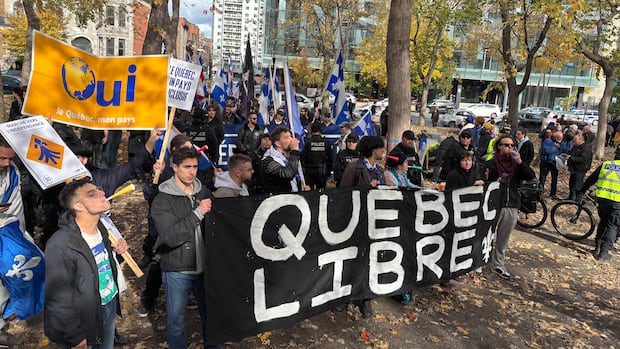
To commemorate the 30th anniversary of Quebec’s last referendum, hundreds gathered in Montreal’s Plateau Mont-Royal area to revitalize the sovereignty movement. A majority of attendees were younger individuals, expressing hopes for a future referendum.
Students Laure Fateux and Olivia Bégin from the francophone college Cégep du Vieux Montréal shared that a significant number of their peers identify as sovereigntists.
“It’s crucial for Quebec to become a country to protect its culture, language, and history,” Fateux remarked.
Bégin mentioned that her parents and grandparents supported Quebec’s independence in both 1980 and 1995, adding that it is clear her generation is breathing new life into the movement.
Leonard Vidal, also a student at Cégep du Vieux Montréal, expressed that he believes independence is the only path for Quebecers to break free from the current Canadian governmental system, which he described as a “colonial, petroleum state.”
Catherine Lamoureux-Schmidt, a student at L’Université du Québec à Montréal, concurred, asserting that “the only way to achieve that is to become a country.”
Both Lamoureux-Schmidt and Vidal are part of a province-wide coalition of student organizations advocating for Quebec’s status as an independent nation. They noted that this coalition has expanded from five groups to 22 over the past year, maintaining a strictly non-partisan stance.
Lamoureux-Schmidt expressed her support for establishing a “nation-to-nation” relationship with First Nations in Quebec, emphasizing the importance of listening to them in the process of nation-building.
Like many others present, she expressed her hope to see another referendum during her lifetime.
“More than half of the nation hasn’t had the opportunity to express their views on this matter, so it’s essential to bring this question back to the public,” she stated. “We want to take control of our future.”
Pablo Rodriguez, leader of the Quebec Liberal Party, addressed the party’s members’ assembly in Trois-Rivières, acknowledging that an independent Quebec could be possible but would also face significant economic challenges, echoing concerns raised by previous leaders.
“We wouldn’t enjoy the same level of economic standing, we wouldn’t be within the G7, and we would have to renegotiate our trade agreements,” Rodriguez, a former federal minister, explained.

