
The campaign titled “Duck Lake Forever” has emerged to mobilize community members in efforts to safeguard the heritage of their historic town.
This initiative was sparked by the mayor’s announcement last week regarding plans to auction the naming rights of the town, which has a population of approximately 580 and is situated about 80 kilometers northeast of Saskatoon.
The name Duck Lake is thought to have originated from the term “See Seep SaKayegan,” used by First Nations people to refer to the local body of water, highlighting the large number of migrating ducks that visit during spring and fall, as stated on the Town of Duck Lake’s website.
It is primarily recognized as the significant location of the 1885 Battle of Duck Lake, one of the initial confrontations in the Northwest Resistance, led by Louis Riel.
Local resident Adam Carriere mentioned that he and his partner initiated Duck Lake Forever to oppose the proposal. They are highlighting an online petition that had garnered hundreds of signatures by Monday afternoon.
The petition argues that altering the name would erase a vital part of Duck Lake’s Métis heritage and identity, asserting that the town’s name is “a legacy that deserves to be preserved for future generations.”
“The Battle of Duck Lake holds significant importance in our history. For the Métis community, residing in the historic town of Duck Lake is a source of great pride for us,” Carriere noted.

Adam Carriere created a “Duck Lake Forever” Facebook page and encourages people to support the online petition aimed at preserving the town’s name. (CBC News)
He expressed concern that a partnership with a private entity could leave residents at risk if commitments are not honored, potentially resulting in taxpayers bearing the costs for new signs and rebranding efforts.
“If they fail to uphold their end of the bargain, it would be our legal team against theirs, and we would be at a disadvantage,” he added.
Carriere stated that the campaign organizers aim to present their case to the council and advocate for a community referendum.
“This is a significant risk from which we cannot retreat,” he said. “Whatever decision is reached here, we will have to accept it.”
Mayor Jason Anderson of Duck Lake told CBC News that selling the town’s naming rights could generate funds necessary for repairing deteriorating infrastructure, such as roads and water lines, and emphasized that any name change would ultimately require approval from residents through a referendum.
Former mayor joins effort to save name
Denis Poirier, a former mayor of Duck Lake, indicated that he and his family intend to sign the petition.
Poirier has lived in Duck Lake for 55 years and has been a member of the town council for 31 years, including seven years as mayor.
He emphasized that the town’s history is fundamental to its identity, and changing the name would impose burdens on residents.
“This impacts everyone from the RM [Rural Municipality], as well as those from the [Beardy’s Okemasis First Nation] reserve, because their mail is delivered in Duck Lake. Thus, their addresses would need to change,” Poirier explained.
“Our driver’s licenses, passports, health cards, so many documents would require updates… And who bears the cost of that? Certainly not the town. It would fall on the residents.”
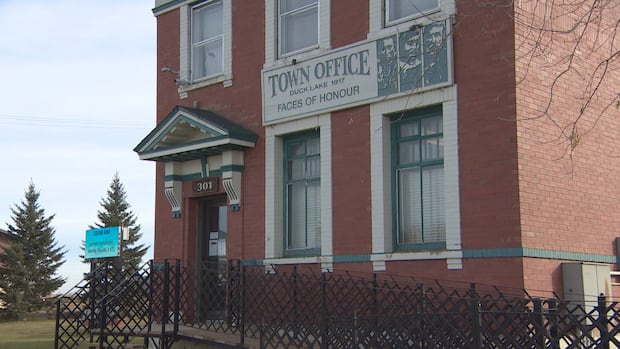
The town of Duck Lake is putting its name up for sale. Mayor Jason Anderson stated that any potential name change must honor the community’s deeply-rooted Canadian history.
Nevertheless, Poirier remains hopeful that community involvement could lead to a positive outcome.
“If we unite and support these petitions while conveying our discontent, perhaps they will recognize our stance and halt [the proposal] immediately,” he remarked.
Idea not ‘practical,’ marketing prof says
Marvin Ryder, a marketing professor at McMaster University, noted that while the notion of selling a town’s name isn’t completely unheard of, it is quite uncommon.
He cited a few instances in the United States, such as the small city of Truth or Consequences in New Mexico, which changed its name in 1950 due to a radio show competition (previously known as Hot Springs). Topeka, Kansas, temporarily rebranded as ToPikachu on two occasions in 1998 and 2018 to celebrate Pokémon releases.
Ryder indicated that there is no precedent for a Canadian town pursuing a similar approach, suggesting that the mayor’s proposal may be designed more for publicity purposes.

Marvin Ryder, a marketing professor at McMaster University, believes the sale of Duck Lake’s naming rights may be more about attracting attention. (CBC)
“I can’t help but wonder if he is genuinely serious about this or simply attempting to embarrass the Saskatchewan government,” he stated.
“Here I am, appealing for someone to purchase the naming rights to my town so I can fund infrastructure improvements. Perhaps the Saskatchewan government should explore implementing a program to assist smaller communities with infrastructure needs.”
While he acknowledged the town’s creativity, Ryder asserted that the idea is impractical.
“The traditional saying is that all publicity is good publicity,” he remarked. “However, in terms of practicality, this is not the proper route to take.”

